

Learn the Facts:
Single-Use Plastic Bags.

Plastic bags are everywhere.
At the grocery store, the farmers market, the mall, food trucks, restaurants and more…single-use plastic bags are everywhere. Unfortunately, that includes Virginia’s lands and waterways! With an estimated population of 8.72 million people, Virginians consume nearly 3 billion bags annually.
The use of plastics, which has exponentially increased in recent decades, poses a significant threat to Virginia’s environment and economy. Taking the time to explore this site is a great first step towards combating plastic pollution and litter in your community. All info here has been rigorously researched by scientists, litter experts, and other sustainability professionals. Once you’ve learned the facts, it’s time to take action.
Plastic bag policies work.
Since the enabling legislation passed through the Virginia General Assembly in 2020, several localities across the Commonwealth have adopted local $0.05 disposable plastic bag taxes. Read more about the disposable bag tax and several success stories below.
Virginia localities with plastic bag taxes (fees).
-
Albemarle County’s $0.05 bag tax went into effect January 1, 2023.
-
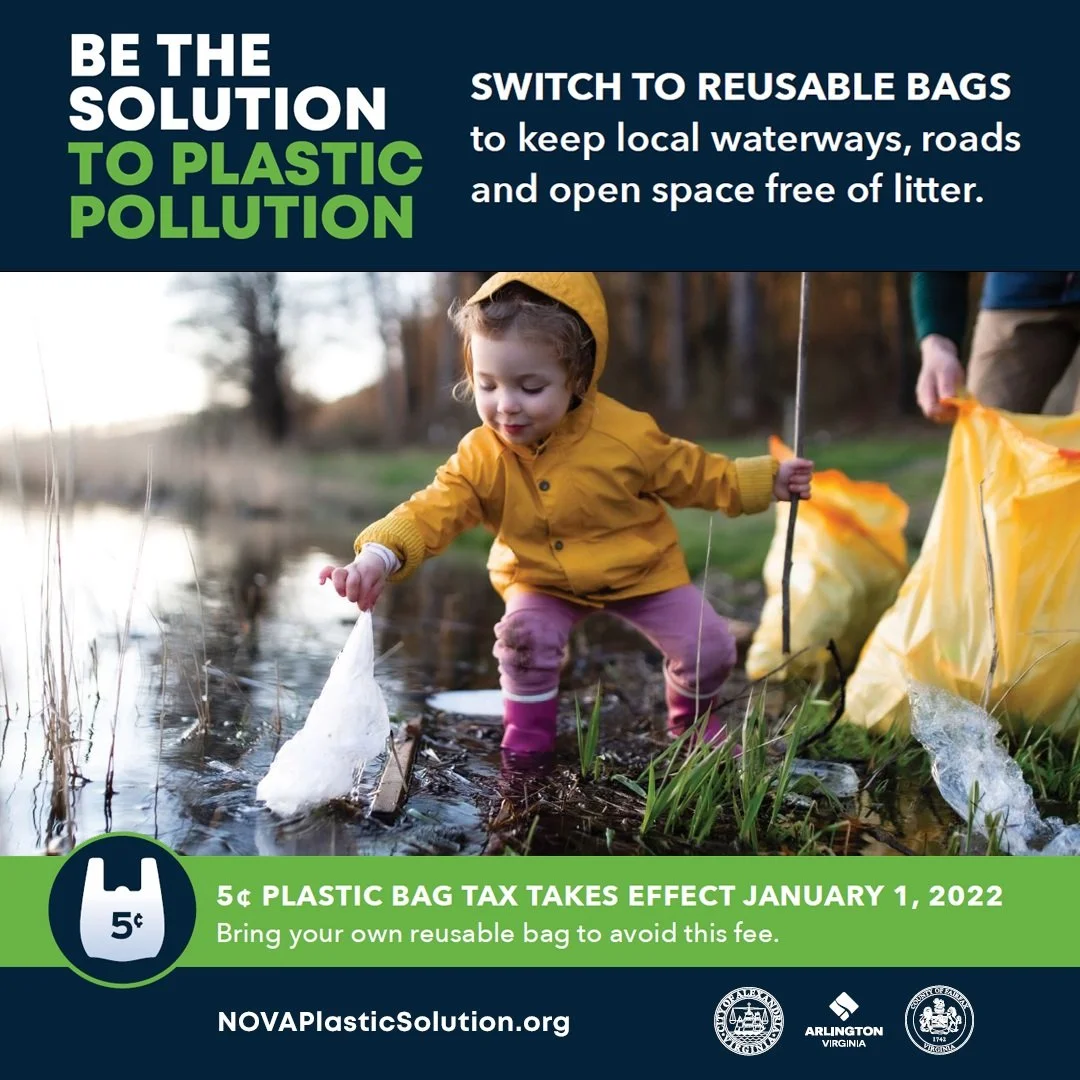
The City of Alexandria enacted a $0.05 bag tax January 1, 2022.
-
Arlington County’s $0.05 bag tax went into effect January 1, 2022.
-
The City of Charlottesville’s $0.05 bag tax went into effect January 1, 2023.
-
The City of Fairfax’s $0.05 bag tax went into effect January 1, 2022.
-
Fairfax County’s $0.05 bag fee went into effect January 1, 2022. Since that time, the average number of plastic bags found at stream monitoring sites has decreased by 47.27% (Clean Fairfax). This trend is also supported by data collected from Ocean Conservancy’s TIDES database. Pre-tax (years 2019-2021), plastic bags represented nearly 20% of all litter items reported in cleanups. In 2023, bags represented just 4% of litter collected.
This means that fewer bags are getting loose into the environment, which is certainly a good thing. However, plastic bags are still being used in Fairfax County. In fact, the Fairfax County Plastic Bag Fee Fund collected approximately $2 million in its first year of operation–at a nickel a piece, that’s an astounding 40 million bags charged for! This is a double-edged sword because while the funds from the bag fee are specifically dedicated for environmental projects, the money collected is directly dependent on people using more plastic bags.
-
The City of Falls Church’s $0.05 bag tax went into effect April 1, 2022.
-
The City of Fredericksburg’s $0.05 bag tax went into effect January 1, 2022.
-
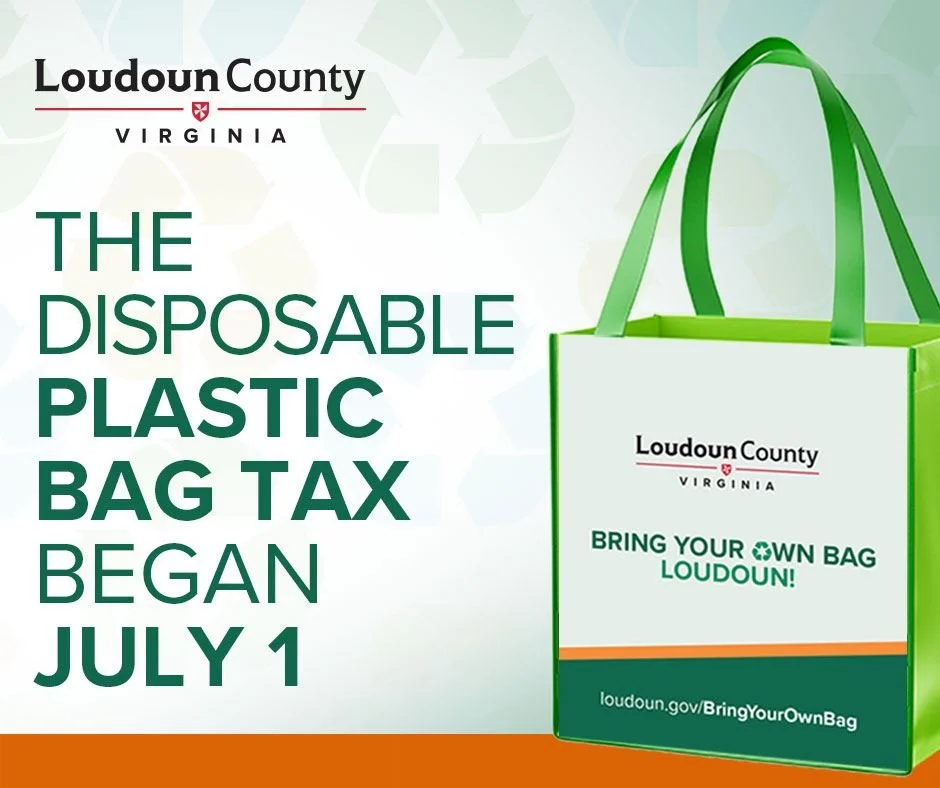
Loudoun County’s $0.05 bag tax went into effect July 1, 2022.
-
The City of Roanoke’s $0.05 bag tax went into effect January 1, 2022.
-


Bag fee talking points.
Research has shown that bag fees are one of the most effective ways to curtail single-use plastic bag litter.
Litter Free Virginia has written up the talking points below so that you can be an effective advocate for a bag fee in your locality. If you’d like more detailed insight or to discuss getting a local bag tax enacted in your locality, please reach out to us at cfc@cleanfairfax.org.
The “Four E’s” make a compelling argument for adopting a local bag fee.
-
Misconception:
Plastic bag fees are a bad idea because they disproportionately harm vulnerable communities.
Refuting information:
Plastic bag fees can be waived for certain communities (SNAP, WIC) and often the fee is fed back into the community to provide reusable bags! For example, Fairfax County’s ordinance allocates bag tax funds to provide reusable bags to SNAP and WIC participants.
The average cost per household is only about $5 per year!
-
Misconception:
A plastic bag tax would be a financial burden on taxpayers and disproportionately harm vulnerable communities.
Refuting information:
Fee versus tax
Plastic bag fees are a fee, not a tax. A fee which we can all elect out of by bringing a reusable bag or container:
“Tax is the compulsory payment to the government without getting any direct benefits. Fees are generally obligatory to regulate or control various types of activities. However, a fee is particularly applied for the use of a service. A tax is a compulsory contribution made by a taxpayer. A fee is a voluntary payment.”
Clean-ups cost!
In 2020, the litter taxes generated $1,864,527, about $0.22 per Virginia resident.
These taxes are spent by litter-producing companies to clean up the problem they are creating.
Further, before the 2020 General Assembly, the litter tax in Virginia had not been adjusted for inflation since its inception over 45 years ago.
Nothing is free
Plenty of businesses (e.g. Aldi, Trader Joe’s, Costco) already don’t offer any bags.
For the initial year, stores keep $0.02 of every $0.05. After that, stores receive $0.01 of every $0.05 fee.
Retailers already embed the cost of these single-use products in their operating costs.
According to the U.S. International Trade Commission, plastic bags cost U.S. retailers an estimated $4 billion annually, and individual retailers can spend between $1,000-$6,000 monthly on plastic bags.
“The 100 billion plastic shopping bags in use each year in the U.S. are made from the estimated equivalent of 439 million gallons of oil, and they cost retailers an estimated $4 billion.”
-
Misconception:
Single use plastic products are safer than reusable products.
Refuting information:
Single-use isn’t sustainable
While single-use plastic bags do have lower emissions, consumers use considerably more of these bags and these bags are more environmentally persistent.
Recycled cotton for reusable bags isn’t driving climate change – single use plastics are a significant factor driving climate change.
Cotton is a natural and durable fiber, while plastic is made from fossil fuel and can only be “downcycled” into more plastic (requiring energy and thus greenhouse gas emissions).
Recycling, as it stands, can’t be the sole solution
Technology and clean-ups alone can’t address single-use plastic pollution.
“Reducing emissions requires drastic actions, like capping the production of virgin plastic to increase the value of recycled plastic, and banning export of plastic waste unless it is to a country with better recycling” says Tekman.
Recycling rates for single-use plastic bags are extremely low (<10% of plastic is recycled).
“Advanced” recycling is problematic
“Advanced” recycling or chemical conversion of plastic (the process of heating up plastic with chemicals) still makes more plastic!
Chemical conversion emits further greenhouse gases and has been flagged as problematic in the EU:
“Throughout this report the overriding finding is that there is a general lack of transparency or robust evidence base that can be used to verify claims or generate firm conclusions around the viability of many [chemical conversion] technologies… At the commercial scale (or close to it), the competition to be first to market is strong and this appears to limit publicly available evidence. This also means that caution must be exercised as a lack of evidence can mean either a knowledge gap or that the answer is less favourable…
Even when compared with a relatively poorly performing mechanical [traditional] recycling scenario, current pyrolysis oil to monomer processes [chemical conversion] appear to be too energy intensive to compete.“
-
Misconception:
Single use plastic products are safer than reusable products.
Refuting information:
Microplastics have been found in table salt, drinking water and air.
Microplastics are found in food.
Ingestion of plastic has drastic human health implications, including negative impacts on reproductive fertility.
Myth Busters
-

"Plastic bag bills don't work"
Yes they do. It’s fair to say that some work better than others, but there’s ample evidence that bag bills do work, and little to no evidence that they don’t.
-

“Plastic bags are recycled!”
It’s true that many grocers offer plastic bag recycling. It’s also true that these programs have failed, impressively. In fact, The World Counts estimates that less than 1% of plastic bags are recycled. In other words, 99% of all plastic bags are ultimately thrown away. Some research has shown that offering recycling can actually increase the consumption of free items because people believe they are engaging in a pro-environment behavior.
-

“Plastic bag recycling provides jobs!”
None of the presented bag bills would adversely hurt companies that use recycled plastics such as Trex in Winchester, VA, as there is a plethora of plastic available to recycle in the United States.
If someone says this to you, ask them to prove it! With numbers!
-

“I reuse my plastic bag! I pick up after my dog with plastic bags!”
Woof! While we completely appreciate the reuse of plastic bags, this does not justify the production and use of billions of plastic bags each year. Retailers and tax-payers should not be required to supply pet owners with plastic bags free of charge. Pet owners (and everyone else) should purchase their own bags, which illustrates to them that there are real costs to these materials.
-

“Plastic bag litter only makes up a small portion of the litter”
It’s important to note that yes, there are many sources of pollution that need to be curtailed. But plastic bags are a big source. According to Clean Virginia Waterways, plastic bags are always among the top 10 littered items found during Virginia cleanups.
-

“Retailers will flounder under the fee”
Unfortunately, retailers (and customers) already pay the fee, it’s just not obvious to the public. By making a fee explicit, retailers won’t have to pay for bags at all, and people can choose whether it’s something they need.
-

“Plastic bags create less greenhouse gases than paper or reusables”
This is a gray area and a small point of contention in the environmental community. The production of one disposable plastic bag creates less GHGs than one reusable bag. To make the math work you must, you know… reuse your reusable bag to make it sustainable. And some reusable bags, like cotton bags, may never be used enough to be a truly “green” option. Still, most experts agree that a reusable bag sourced from sustainable or recycled materials is the best option when considering environmental health. This is a moment to emphasize that bag taxes (fees) are only a starting point. Educating the public about maximum reuse of bags will be necessary to make the most out of this opportunity!
-

“Citizens cannot afford the financial burden of this fee”
While concern for fellow Virginians’ financial welfare is admirable, it’s unfounded. LA County studied the economic consequences of a bag fee and found a maximum burden of $3-4 a year per household. Even this is likely an overestimate. Reusable bags are already incredibly common in US households, and many non-profits in Virginia give away reusable bags free-of-charge. Furthermore, Virginia spends millions of dollars a year cleaning up litter on the tax-payers’ dime. Additionally, an unhealthy Bay endangers the local fishing and tourism industries. No one wants to tan on a littered beach or slurp from an oyster shell filled with microplastics. Cotton farmers loathe plastic bags because bags catch in the gin and contaminate entire bales. It seems that citizens cannot afford the harmful effects of plastic bags.
-

“Plastic bags are sterile – reusable bags harbor unsafe bacteria”
This is a classic case of lying with data. The American Chemistry Council invested in studies which found high rates of bacteria in reusable bags. This is technically a valid finding (though the methodology is questionable). What isn’t said is that the bacteria found is not harmful. According to Consumer Reports: “A person eating an average bag of salad greens gets more exposure to these bacteria than if they had licked the insides of the dirtiest bag from this study.” Basically, most things in everyday life have bacteria like E. coli lingering on their surfaces. While the risk of food-borne illnesses from reusable bags is very very small, washing your bags occasionally is still a good idea, and rids the bags of 99.9% of all bacteria. And as always, it’s wise to wash any produce you eat, reusable bag or otherwise!